
From Pilot to Proof: PepsiCo’s Zero-Emission Trucks Hit the Streets in South-Central Fresno
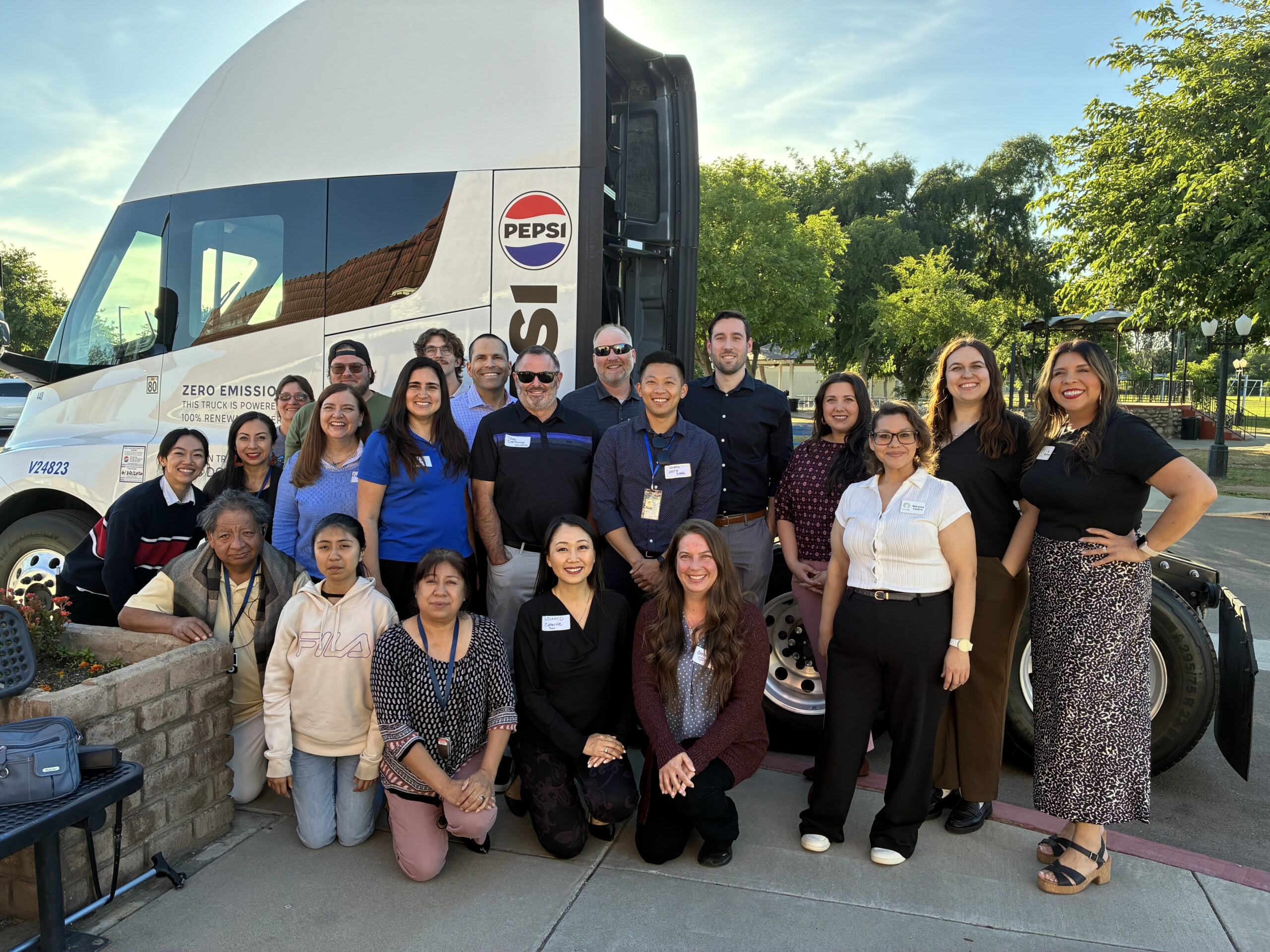
Project team and Malaga community members with one of PepsiCo’s electric trucks
On April 29, 2026, PepsiCo North America (PepsiCo) invited Fresno community residents to the Malaga Community Center to share learnings from the company’s largest collaborative zero-emission deployment to date: the South-Central Fresno Pepsi Delivery Truck Electrification Project. Delivered in both English and Spanish and hosted in partnership with HandsOn Central California, the Malaga community event allowed residents, who have consistently named truck and freight emissions as a priority concern, to see the innovative steps that the fleet is taking to improve health outcomes that diesel-generated pollution has created in the South-Central Fresno community.
As part of this project, PepsiCo deployed fifty battery-electric trucks (BETs) and installed eight 750-kW charging ports and two battery energy storage systems to support the fleet’s energy demand.
Catalyst Mobility’s Data Insights & Analytics team is analyzing one calendar year of real-world Class 8 BET data, evaluating the performance of PepsiCo’s electric fleet and its economic and environmental impacts on the fleet and the community, respectively.
The Big Takeaway: Electrified Fleets Deliver Real-World Impact
In its first year of full operation, the 50-BET fleet traveled 709,864 zero-emission miles, displacing 141,973 gallons of diesel and avoiding 1,449,541 kg of tailpipe carbon dioxide — an amount equal to the emissions from 338 gasoline-powered cars.
For more impressive takeaways from PepsiCo’s South-Central Fresno Project data, read on.
Inside PepsiCo’s South-Central Fresno Zero-Emission Freight Deployment
In 2021, the San Joaquin Valley Air Pollution Control District was awarded a competitive grant from the California Air Resources Board (CARB) and the California Energy Commission (CEC) to deploy Class 8 electric trucks and install charging infrastructure at PepsiCo’s freight facility near the South-Central Fresno community. South-Central Fresno is a designated AB 617 community, meaning it’s one of many California neighborhoods disproportionately burdened by environmental pollution. The community sits at the intersection of agricultural operations, freight corridors, and industrial activity, making drayage, or short-haul freight trucking, one of the most significant sources of local diesel pollution. The South-Central Fresno Pepsi Delivery Truck Electrification Project was designed to reduce smog-forming emissions and greenhouse gas emissions annually, directly targeting this harm.
Through this grant, CARB, CEC, and PepsiCo collectively invested $26 million in deploying 50 Tesla Semi BETs at PepsiCo’s Fresno freight facility. The fleet also installed and commissioned eight 750-kW charging ports and two battery energy storage systems at the facility’s charging depot to support the trucks.
One Year of Real-World Data from PepsiCo’s Electric Fleet Operations
All 50 Tesla Semis were received between June and December 2024. By that time, all eight charging ports were commissioned and operational using PG&E’s Flex Connect Pilot Program, which coordinates a site’s power demand based on when supply is readily available. This allowed PepsiCo’s Fresno charging ecosystem to be energized in the near term, despite broader grid capacity constraints in the heavily commercial and industrial zone.
The data collection period for the BET deployment ranged from February 2025 through February 2026, representing one calendar year of operation.
Duty Cycle and Utilization
PepsiCo’s trucks operate across two distinct duty cycles: regional distribution and long-haul transport. The regional distribution vehicles serve delivery routes in Fresno and surrounding communities. PepsiCo qualifies all non-regional distribution routes as long-haul. The industry’s benchmark for long-haul is generally 500 miles or greater; by comparison, PepsiCo’s long-haul transport vehicles serve single-trip freight corridors spanning approximately 350 to 477 miles. Early results show that BETs are suitable for sustained highway driving, where steady speeds and minimal idling let them operate at their most efficient.
Range anxiety is a common concern for fleets considering heavy-duty BET adoption; however, the BETs assigned to long-haul routes in this deployment demonstrated that the technology could make these long-range trips with few challenges. After the first full year of operation, the data showed that not a single truck out of the 50-truck fleet was stranded with a depleted battery — not bad for 709,864 total miles traveled.
What’s Next for Zero-Emission Freight in California’s Central Valley
Going forward, Catalyst Mobility’s Data Insights & Analytics team will finalize the analysis for PepsiCo’s BETs and charging infrastructure.
Keep an eye out for further key findings and insights from this project: This post is the first in a series exploring what the South-Central Fresno deployment can teach the industry. As this first year showed, BETs can already handle demanding freight corridors reliably. Furthermore, for fleets working within grid constraints, on-site storage and utility coordination is fundamental to the success of the deployment.
Upcoming entries will explore the project’s post-completion data results, as well as PepsiCo’s collaborative efforts with local educational institutions at the high school and junior college level and businesses to update their curriculum, preparing students for future careers in zero-emission trucking. In this series, Catalyst Mobility will also explore the partnership between PepsiCo and PG&E, whose FlexConnect program shows how fleets and utilities can work together to electrify even where grid capacity is tight.
The Fresno deployment shows that heavy-duty fleet electrification can work at scale today. For other fleets considering electrification, the question is no longer whether the technology works — it’s how soon they can put it to work on their own routes.