Zeroing In: A Conversation About Zero-Emission Bus Data
The Zeroing in on Zero-Emission Buses (ZIO ZEB) report is CALSTART’s annual snapshot of zero-emission bus adoption in the United States. Since 2018, it has become a trusted industry benchmark for understanding growth in zero-emission transit and the advanced technologies shaping the industry.
To explore the latest findings, Transition to Zero podcast host Jared Schnader, Executive Vice President of Initiatives at CALSTART, spoke with Mike Hynes, Deputy Director of Transit at CALSTART, and Kaila Ketelsen, Project Manager on the Data Insights & Analytics team at CALSTART. Their conversation highlights key insights from the most recent report and how adoption is unfolding across the country. The conversation has been edited for clarity and length.
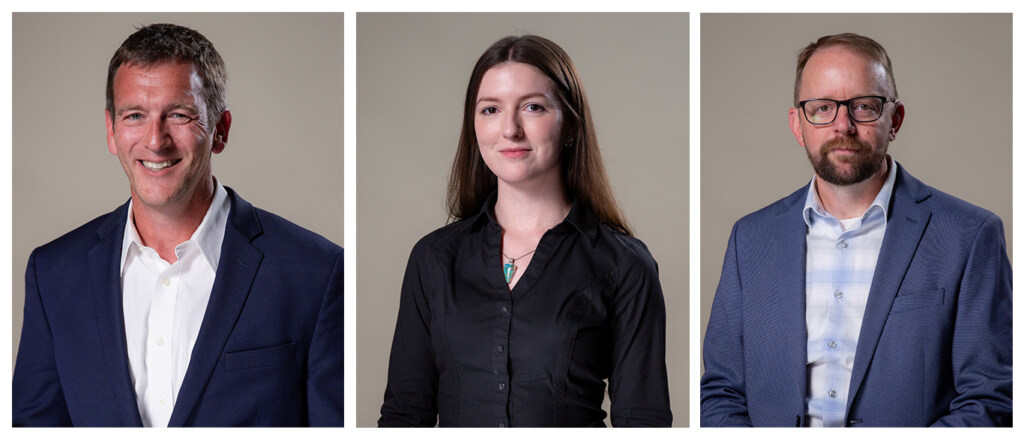
From Left to Right: Transition to Zero podcast host Jared Schnader, with CALSTART report authors, Kaila Lemons and Mike Hynes.
Jared Schnader: Mike, what is the ZIO ZEB report?
Mike Hynes: ZIO ZEB is CALSTART’s annual report that tracks the adoption of zero-emission buses across the United States. We look at which fleets are adopting these vehicles and how they are being ordered, procured, and deployed. We really try to provide a comprehensive view of what the zero-emission landscape looks like, and this report is the only one of its kind that does this. It’s been an effort that changes year over year to provide more in-depth data and give transit agencies, stakeholders, and CALSTART members a comprehensive look at where these buses are being deployed, what the challenges are, and, more importantly, what the opportunities are.
Jared: Looking at the national landscape, what stood out to you in this year’s findings?
Mike: The biggest takeaway for us is the continued growth, despite real headwinds in the industry. We know there are challenges in the market and with funding, yet that growth signals the resilience of these agencies. They are continuing to find ways to get these vehicles into service. We saw more than 8,100 full-size ZEBs and nearly 1,400 small ZEBs, which is about a 16% increase year-over-year. That positive movement shows these solutions are viable and beneficial.
Jared: Was that growth concentrated in one area, or was it dispersed across the country?
Mike: In years past, it was often quite concentrated in places like California or New York, but what we see particularly this year is that it is nationwide. There are now deployments in 48 out of 50 states. We’re seeing it across operating conditions and across the transit spectrum — from large fleets like LA Metro and the New York MTA down to mid-sized ones like Champaign-Urbana in Illinois. It speaks to the maturity of the technology that fleets in Indiana, Texas, Florida, Georgia, Washington, and Montana have all recognized how they can deploy it.
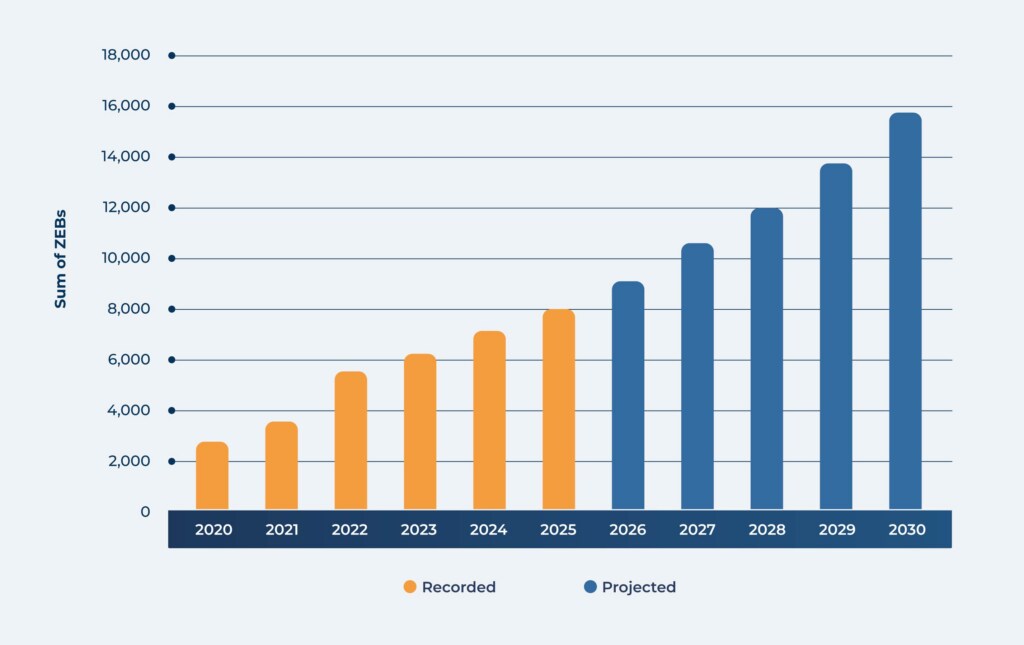
Full-size zero-emission bus fleet historical and projected growth through 2030 from the latest ZIO ZEB report.
Jared: Kaila, I’ve heard you say this report is evolving into a “data ecosystem.” Can you explain what that means?
Kaila Ketelsen: Over the past 3 years, the technical abilities of our Data Insights and Analytics Team have really advanced. We now have a centralized data lake that houses datasets from all our projects. We’re developing web-based tools, dashboards, and maps to make this data more accessible to the public. We aren’t looking at things as standalone projects anymore; we’re focusing on them as scalable and interoperable assets. It’s a bit like each project is a newspaper clipping on a bulletin board that I am connecting with string into a bigger picture so we support more informed strategic decision-making with industry stakeholders.
Jared: How are you validating the data you receive?
Kaila: It’s a long process. We start with three primary categories of data: federal awards, state awards, and primary data that we get back directly from fleets. After compiling it, we send it out to the fleets so they have an opportunity to check what we’ve added, make updates, or tell us if a bus’s status has changed. Beyond that, there are manual procedures like cleaning out [vehicle] models that don’t fit the scope or making sure award data is attributed correctly. Ultimately, the data is more reliable long-term because it’s in an advanced system rather than just living in Excel spreadsheets.
Jared: Battery-electric versus hydrogen — what are we seeing in the technology split?
Mike: Battery-electric still leads the charge, no pun intended, but fuel cell growth has been dramatic, from 45% last year to 55% this year. Agencies are taking a more measured approach, looking at how these systems best fit their specific routes and service profiles. We’re also starting to see more fleets doing a mix of both. Some agencies are even looking back at their older transition plans and course-correcting to fuel cell because it may fit their specific needs or specific routes better.
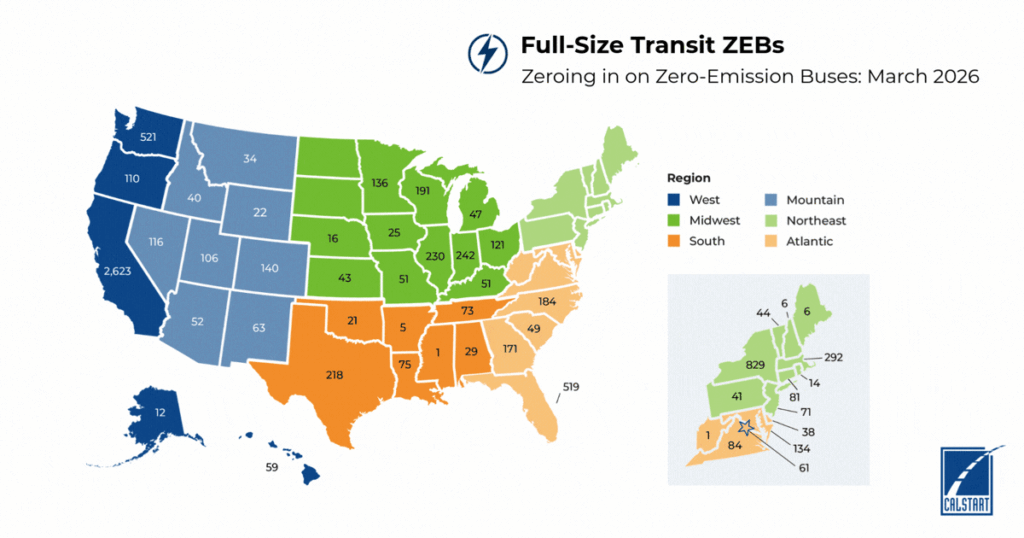
Regional expansion of full-size transit zero-emission buses throughout the United States, based on data from CALSTART’s 2026 ZIO ZEB report.
Jared: Were there any patterns that surprised you in the data this year?
Kaila: We saw really strong growth in the Midwest: up 69% from last year, which is almost 400 buses. For the first time, Nevada, Louisiana, and Wisconsin made our top 10 list of states with the largest increase in full-size zero-emission buses. And Florida is currently in fourth place for the most zero-emission buses in the country.
Jared: What are you seeing in terms of trends for fleet transition plans?
Mike: Many agencies are moving away from developing a plan just as a step in the process before procurement. They’re recognizing that adoption is an “S-curve” and are taking a more long-term approach, developing full, detailed plans for procurement, infrastructure, and workforce development. We’re also seeing agencies become okay with the fact that plans can and should change, and they’re learning from their peers and technology maturity to make modifications without starting over from scratch.
Jared: For transit agencies facing an onslaught of data and information, what insights are most beneficial?
Kaila: The most important thing to remember is that growth is steady, which means there are many other players in this industry to rely on and collaborate with. I suggest looking at agencies near you that have training facilities that you could check out or workforce development programs you could borrow from. Take those key lessons and then customize them to your particular context.
Jared: Have you seen specific workforce development models that you would recommend?
Mike: AC Transit has done a lot of work and really pioneered the Augmented Reality (AR), Virtual Reality (VR), and Extended Reality (XR) space for training, and they’ve been very willing to share their lessons learned. I also think of consortium models, like what is being done at NEORide. They pull multiple agencies together to pool resources and funding to develop training programs. If agencies go it alone, it’s challenging, but if they work together, they can scale much quicker.
Jared: As agencies explore adoption, what final advice would you give them?
Mike: Broad adoption means that the technology works. It’s no longer a question of “should I pilot it?” but rather “how do I integrate it into my fleet?” and “how do I scale?” There is a wealth of knowledge out there through reports like this and through your peer networks. Leverage the resources and technical assistance available to you, because the support is there if you tap into it.
Interested in more?
- Listen to Jared’s Transition to Zero episode with Mike and Kaila: Zeroing in on ZEBs Report: 2026 – Transition to Zero | Podcast on Spotify
- Read the full report: Zeroing in on Zero-Emission Buses