
Not Pulp Fiction: Orange EV’s Orange Juicer Will Prove Fruitful for the Industry
Developed through a collaboration between truck OEM Orange EV and its subsidiary, infrastructure solutions specialist OptiGrid, the Orange Juicer battery integrated DC fast-charger is working to transform zero-emission transportation. The new charger works by collecting AC power from the grid, storing it, and then converting it to DC power to charge vehicles up to 200 kW when needed. This technology allows users to take advantage of current electrical infrastructure and convert power into usable energy for their vehicles, which will help to remove obstacles that normally disrupt EV charging.
CALSTART caught up with OptiGrid CEO, Tyler Phillipi, to learn more about the charger, along with Orange EV and OptiGrid’s efforts in advancing the zero-emission transportation industry. Read more below.
Q: How did OptiGrid come to fruition to support current EV charging needs?
OptiGrid was created to solve one of the biggest roadblocks in fleet electrification: the grid isn’t ready for the pace of demand. Fleets are eager to transition, but many face multi-year waits for utility upgrades or seven-figure infrastructure costs. We saw an opportunity to change that. By acquiring FreeWire’s proven battery-integrated charging technology and combining it with Orange EV’s deep expertise in real-world fleet electrification, we built OptiGrid to bridge the gap. Our approach is straightforward, deliver charging that can be deployed in weeks instead of years, using existing power, without requiring fleets to design and fund their own onsite battery systems.
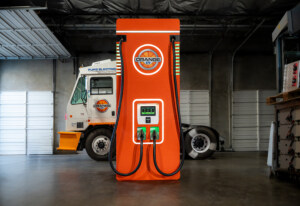
The Orange Juicer, developed by OptiGrid in partnership with Orange EV. Photo: OptiGrid.
Q: How do Orange EV and OptiGrid support each other in projects like developing and releasing the Orange Juicer?
Orange EV has been selling electric trucks for over a decade and knows customer pain points firsthand. OptiGrid builds the charging solutions that solve these challenges. Together, we deliver not just trucks, but the power to run them. The Orange Juicer is the first product of that partnership: Orange EV brings the vehicles and customer relationships, and OptiGrid brings the charging technology to make those deployments possible.
Q: Could you give us a quick breakdown of how the Orange Juicer works?
The Orange Juicer is a battery-integrated DC fast charger – essentially a BESS and DCFC combined into a single UL-certified unit. It connects directly to the available power, so there is no need for utility upgrades, trenching, permitting or lengthy engineering reviews. Because it is a BESS, instead of pulling all the power from the grid at once—which often requires expensive upgrades—the battery charges gradually and then delivers fast charging to vehicles when needed. That makes the whole system easier, faster, and cheaper to deploy.
Q: What obstacles or challenges does the Orange Juicer help to overcome in EV charging?
The two biggest barriers to fleet electrification are infrastructure delays and cost. When fleet operators run out of power to expand their electric fleet, waiting for utility upgrades can take years, spanning from permitting to construction and utility timelines. The Orange Juicer cuts that timeline to weeks. On the cost side, it eliminates the need for a separate BESS installation, which can cost hundreds of thousands, or even millions, of dollars upfront. It also reduces the operational complexity of coordinating across multiple stakeholders.
Q: What are the benefits of using this technology to power fleets?
The benefits boil down to speed, cost, and reliability, which are directly tied to ROI. Fleets can deploy charging infrastructure in weeks, rather than years, which means trucks get on the road faster and start generating savings sooner. Fleets cut upfront capital costs dramatically, and the integrated design reduces downtime risks, keeping vehicles available and productive. Additionally, because the Orange Juicer is modular, fleets can start small and scale up as their adoption of electric vehicles grows. It de-risks the transition to zero-emission operations.
Q: Looking ahead, does OptiGrid have any projects coming up in the near future?
We will launch our first commercial deployments of the Orange Juicer by the end of 2025, starting with fleets that already operate Orange EV trucks. We also have pilots lined up with several logistics and shipping operators. Those first projects will serve as essential proof points to demonstrate how quickly this model can scale across the industry and will be announced before the end of the year.
Q: How do you hope OptiGrid will change the EV charging infrastructure landscape moving forward?
Our vision is to redefine how charging is deployed. Instead of waiting on the grid or sinking massive amounts of capital into a BESS, we’re enabling fleets to move at the speed of business. Over time, this helps individual fleets while creating a more distributed and resilient charging network across the country. If we do our job right, we’ll accelerate the adoption of electric trucks and help decarbonize freight faster than anyone thought possible.
To learn more about the Orange Juicer, read here.
For more information on OrangeEV, visit here. For more information on OptiGrid’s operations, visit their website.