
Spotlight on Battery Thermal Management Systems
While summer is a time when people like to go outdoors and enjoy warmer weather, extreme temperatures are more common than you might think. This season can provide fun opportunities for time outdoors, but it can also bring temperature fluctuations that could affect our vehicles—that is, if they don’t have battery thermal management systems (BTMS).
BTMS are designed and used by manufacturers to ensure that battery temperatures are regulated and maintained while vehicles are in varying temperatures outside. These systems use several methods of temperature control to ensure that batteries are kept safe. To learn more, continue reading below.
BTMS Methods
There are several methods of temperature controls used by BTMS, including air cooling, liquid cooling, phase change materials (PCM) based cooling, thermoelectric cooling, and hybrid cooling. In EVs, the two most common temperature control tools used are air and liquid-based cooling.
These tools often use either passive or active cooling techniques to keep EV batteries at a proper temperature. For BTMS using passive cooling techniques, batteries will be regulated using processes like natural convection, thermal storage from heat-conductive materials, and PCMs. PCMs act as thermal sponges to absorb heat spikes without drawing energy, and instead utilize phase change thermodynamics to remove heat.
For BTMS using active techniques, external energy sources are used to cool the battery. This could include a fan, pump, or coolant that works to adjust temperature increases caused by battery activity.
View the graphic below by Wen et al. (2025) from “Advances and Challenges in the Battery Thermal Management Systems of Electric Vehicles” to see how coolant is used in an active cooling technique.
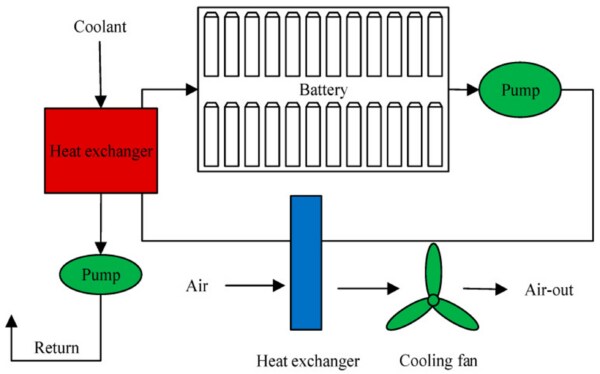
A liquid cooling system. Source: Wen et al. (2025).
In this case, the liquid cooling system works by using a coolant to remove thermal energy from the battery pack, which is then sent through a heat exchanger and passed through a pump or cooling fan to return to the environment outside.
By using either a passive or active cooling system, BTMS can help ensure that batteries do not overheat, which could otherwise lead to unsafe vehicle conditions.
BTMS and Vehicle Safety
Battery performance is highly dependent on temperature. Without BTMS in EVs, the battery would overheat during fast-charging or high-power demand situations, which would lead to accelerated battery degradation, a shorter lifespan, and increase the risk of a battery fire. Low temperatures would dramatically reduce the available range and power output.
Thankfully, with BTMS, EVs are able to regulate the battery’s temperature and ensure operational stability even in extreme climates, extending the battery’s service life and allowing for consistent performance and range. A well-designed BTMS directly influences the durability, power output, and overall drivability of an EV.
In turn, this can also ensure safer vehicle charging with a stable and protected battery system. As well as maintaining ideal temperature for the battery in response to outside temperatures and battery off-heating (i.e. the heat generated by the battery during operation), the BTMS also pre-conditions batteries for charging by heating or cooling to the ideal charging temperature window. By preconditioning the battery, which is typically a warmer temperature than the operational window, the BTMS ensures you get the maximum possible charging speed, reducing your time at the charger while also protecting the battery from stress.
Ultimately, BTMS are responsible for maintaining an EV battery’s proper temperature even while the vehicle is physically somewhere with temperatures that are much hotter or colder than what is ideal for optimal operation.
To dive deeper into BTMS functionality in hotter and colder temperatures, we spoke to CALSTART’s Deputy Director of Battery Manufacturing, Phoebe Bisnoff. Read more below.
Q&A With Phoebe Bisnoff: BTMS and EVs
1. Does BTMS help regulate battery temperatures regardless of how hot or cold it is outside? Does the temperature outside affect how BTMS operates at all?
The BTMS is designed to keep the battery cells within their optimal operating range; this typically 15-35 C (60-95 F). Factors like outside temperature, cabin temperature, current cell temperatures, real-time power demand, charging status, state of charge, battery age, and others dictate the strategy and intensity of how the BTMS achieves target temperature. The methods can vary greatly between manufacturers. Typically, the energy to run the BTMS comes directly from the battery pack, so operating in extreme conditions like a blizzard or a parking lot in the summer in Arizona will consume more energy and affect driving range. The depth of effect on the driving range can vary greatly between EVs. Your cabin climate control will also have some effect on range, not dissimilar from running a gas vehicle’s A/C.
2. Is BTMS something that consumers need to worry about, or is it already a given that their EVs contain these systems that manufacturers have designed and implemented?
Short answer is no. The BTMS does not require any input from the driver. You don’t need to manually adjust anything related to battery temperature. However, it is useful to be aware of its effects: range dropping in extreme temperatures, preconditioning when you navigate a fast-charger, etc. There is no “BTMS score” window sticker but when purchasing a vehicle, you can gage BTMS efficiency by reading reviews that mention real-world range in different climates and watch teardown videos comparing their cooling systems. Some automakers are more transparent about their thermal engineering than others. Ultimately, a sophisticated BTMS is the hallmark of a well-engineered EV that ensures your vehicle can charge quickly, perform consistently, and stay operational for longer.
3. How do you foresee BTMS progressing in the next few years, or near future, in terms of technological advancements?
The next few years will see continuous advancements in predictive and optimized BTMS that considers driving, charging, cabin comfort, and route as an interconnected challenge. Hardware innovations, like immersion cooling and hybrid systems that incorporate PCMs, can pair with multifunctional materials that can manage heat and mechanical load to cut pack weight and energy consumption. At the same time, algorithms like physics-informed neural networks are emerging as a powerful approach to solving complex thermal dynamic problems in real-time. Meanwhile, co-optimization strategies will allow BTMS to coordinate with navigation and charging data to further optimize and personalize efficiency.
Given the expected progression of BTMS technology in the coming years, we are excited to see how manufacturers continue to integrate them into electric vehicles. To stay informed on the latest developments and industry trends, we encourage you to follow CALSTART on social media and keep up with our blogs.