LiCAP Is Redesigning Battery Manufacturing from the Ground Up
CALSTART has members operating in just about every aspect of the clean transportation landscape you can imagine. Some are solving challenges and adding value in charging infrastructure, or last-mile delivery. Some are making an impact on the technology at the very source of it all: batteries.
LiCAP, a CALSTART member based in Sacramento, California, was founded on the belief that optimal chemistry alone isn’t enough to meet the demands of a rapidly electrifying world. “Manufacturing innovation is just as critical as chemistry innovation in advancing energy storage,” said Dr. Richard Qiu, president of LiCAP Technologies. “Early on, we saw that while battery materials were improving rapidly, the core manufacturing process, wet slurry coating, had barely evolved.”
That realization led LiCAP to rethink electrode manufacturing from first principles. The company set out to eliminate solvents and simplify production altogether, beginning with ultracapacitors and lithium-ion capacitors to prove the approach at industrial scale. From there, LiCAP expanded its scope to include batteries, with a consistent focus on translating laboratory breakthroughs into real-world manufacturing solutions.
Traditional battery manufacturing presents persistent challenges, particularly as new chemistries emerge. Solvent-based slurry coating requires significant energy input, long drying times, toxic chemicals, and large factory footprints. These issues are amplified in advanced chemistries such as solid-state batteries, where exposure to solvents can damage sensitive materials and interfaces. As Dr. Qiu explained, “By eliminating solvents and simplifying production, we’re removing one of the biggest bottlenecks to scaling next-generation batteries.”
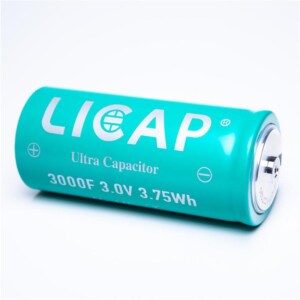
A LiCAP large ultracapacitor cell.
LiCAP’s Activated Dry Electrode technology enables a seismic shift in manufacturing optimization. The solvent-free process forms cohesive, mechanically robust electrodes directly from dry powders, avoiding the need for liquids that must later be removed. “Our Activated Dry Electrode technology forms high-performance electrodes directly from dry powders,” Dr. Qiu said, “preserving material integrity while enabling scalable, solvent-free manufacturing.” The approach maintains low interfacial impedance, supports thick, high-performance electrodes, and is particularly well-suited for solid-state batteries, where solvent exposure can significantly degrade electrolyte conductivity and cell performance.
It’s amazing in theory and in practice. LiCAP works closely with battery manufacturers and automotive OEMs throughout the development and scale-up process to ensure real-world success. Part of the company’s collaboration with Nissan involves the joint development of dry cathode electrode manufacturing for all-solid-state batteries. Nissan has been operating a solid-state pilot line since early 2025, and LiCAP is supporting efforts to ensure the dry electrode process is efficient and scalable as Nissan works toward its targeted commercial rollout in 2028. According to LiCAP, these partnerships are intentionally collaborative and focused on manufacturability rather than prescribing specific chemistry choices.
That flexibility is central to LiCAP’s chemistry-agnostic philosophy. “No single battery chemistry will serve every application,” Dr. Qiu said. “By remaining chemistry agnostic, we allow manufacturers to future-proof their investments and adapt to new materials without rebuilding their factories.” LiCAP’s platform works across ultracapacitors, lithium-ion systems, and solid-state designs, providing a consistent manufacturing backbone as battery technologies continue to evolve.
The proof is in the performance, as recent data from partners continues to demonstrate the potential of this approach. Nissan has stated that solid-state cells “have the potential for approximately twice the energy density of conventional lithium-ion batteries, significantly shorter charging times due to superior charging and discharging performance and lower costs due to less expensive materials,” and that it plans to deploy solid-state batteries “in a variety of vehicle segments, including pickups.”
Looking ahead, LiCAP is focused on expanding its production facilities, increasing manufacturing capacity, and supporting additional automotive and grid-scale energy storage programs. The company is also extending its dry electrode technology into adjacent applications, including stationary battery storage.
And what’s next for dry electrode manufacturing as a whole? LiCAP aims to establish the process as a new industry standard, one that enables safety, efficiency, and sustainability, right from the source.