
Top 10 EV Battery Trends in 2025 and What We Can Expect in 2026
In this blog, we will highlight the top 10 EV battery trends in 2025; from second-life battery use to enhanced grid integration for charging systems, we’ve got you covered. We will also talk about how these trends might spill over into 2026 and inspire similar innovations that are sure to transform EV technology this year.
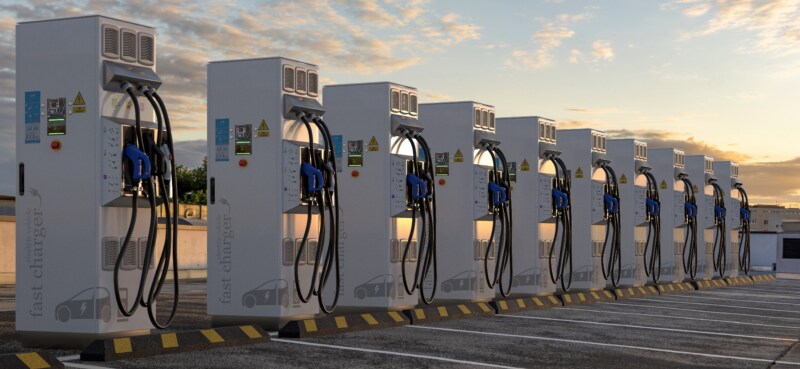
Electric vehicle fast-chargers.
1. Ultra-Fast Charging Technology
First up on the list is ultra-fast charging technology, which is rapidly redefining what is possible for EVs, shrinking charging times from hours to 30 minutes or even less. EV batteries are now able to get charged using a variety of systems, including (but not limited to): alternating-current (AC) charging levels 1 and 2, as well as direct-current (DC) charging levels 1 and 2. There are even extreme fast charging (XFC) systems available for some passenger EVs to fuel up quickly and hit the road.
Source: The Battery Magazine.
2. Battery Recycling and Second-Life Use
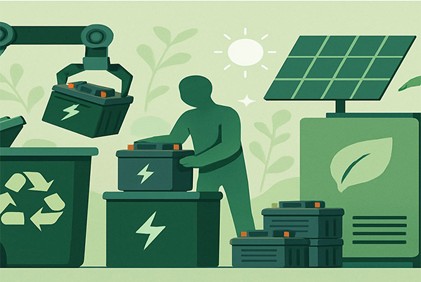
As EV adoption increases, second-life applications and battery recycling are now becoming increasingly common. Not only do they allow for more use out of a single battery, but they also contribute to sustainability efforts driving the clean transportation industry as a whole. In 2025, researchers broke barriers by discovering new ways to extract critical metals from EV batteries.
In the coming years, we will begin to see a wave of older EV models reaching end-of-life and we are already beginning to see emerging policies develop to promote the repurposing and recycling of these batteries.
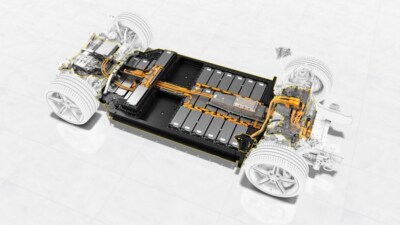
800-volt battery system model. Source: Porsche.
3. High-Voltage Batteries
Similar to the XFC charging systems, the EV battery industry has seen a new player in the emergence of high-voltage battery systems, particularly with 800 volt (800V) battery architectures. This high-voltage battery trend has been on the rise for several years now because higher voltage enables faster charging time, decreased weight, and increased thermal efficiency. The appeal of 800V is no longer a dream and may become a reality for fleets across the industry craving more power for their vehicles.
4. Enhanced Grid Integration for EV Charging
2025 didn’t just usher in maximum power enhancements for EV batteries, it also brought more efficient connections to those power grids that matter so much. With enhanced integration between the electrical grid and charging networks, EV batteries and chargers can be designed to send energy back to the grid when demand peaks.
Additionally, enhanced grid integration research shows that integrating machine-learning into charging systems can adjust charging according to current conditions and potential to reduce charging time. This could allow for more efficiency and grid support not necessarily achieved by traditional charging systems. There is potential for V2G technologies to integrate EV batteries into this machine-learning technology as new innovations are made.
5. Thermal and Climate Adaptive EV Charging Systems
Similar to these machine-learning enhanced systems, 2025 gave rise to more discovery into thermal and climate adaptive EV charging systems. These systems can adapt protocols to extreme temperatures and environmental conditions to ensure that drivers are charging safely and efficiently.
We saw a number of proposals for new adaptive tools in charging systems in 2025, including temperature-controlled smart charging and battery temperature control. If implemented, these tools could optimize battery efficiency. These innovative thermal management solutions with continue to develop in 2026, as charging system manufacturers test how different adaptive charging technology can improve charging speeds, efficiency, and safety.

CATL LFP battery. Source: CATL.
6. Sustained Rise in Lithium Iron Phosphate (LFP) Batteries
In 2025, the deployment of LFP batteries surpassed nickel-based chemistries for the first time, with a in demand globally, with China and Europe leading the way. These batteries have gained traction among US companies like Ford, General Motors, Tesla, and Rivian for their low cost, increased safety, and increased cycle-life. We are excited to see how LFP grows in the U.S. market and abroad, especially as manufacturers ramp up their vehicle offerings in 2026.
7. Cost Reductions
In a similar vein, EV battery technology soared to the top of the headlines last year, with BloombergNEF announcing that battery prices had dropped significantly since 2024. Specifically, they found that lithium-ion battery pack pricing had dropped 8% since then, costing $108 per kilowatt-hour. These cost reductions are likely to continue into the new year, with Goldman Sachs previously reporting in 2024 that they expected EV battery prices to drop by almost 50% in 2026, as compared to their 2023 price levels.
8. AI-Driven Battery Management Systems
Before we get into more emerging technology trends for 2026, let’s talk about AI. Similar to the machine-learning charging integrations, Machine learning driven battery management systems are being considered for system optimization and adaptability, but it also has potential to monitor and communicate charging status and vehicle health for fleet operators take steps to address their vehicles’ needs.
9. Solid-State Batteries: Continued Challenges
Solid state batteries have long been a “holy grail“ for Li-ion batteries because they offer a path beyond the theoretical energy density limits of conventional liquid-electrolyte cells. In a nutshell, these batteries replace liquid electrolytes with ceramics or polymers enabling the use of lithium metal anodes to achieve a higher energy density than traditional lithium-ion based batteries.
A number of companies have announced new vehicle offerings with SSBs, including Dodge and Mercedes-Benz signaling continued industry investment in the technology. Although there remain many critical engineering challenges to scalable manufacturing, steady progress in material science and engineering suggests that these barriers may eventually be overcome, bringing commercial viability incrementally closer.
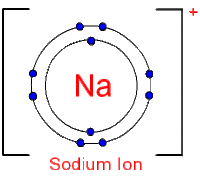
Sodium ion atomic structure. Source: GCSE Science.
10. Sodium-Ion Batteries: Rises Again
To close, we turn to a technology that has experienced both significant headwinds and notable breakthroughs over the past year. Sodium-ion batteries have long been positioned as a potential alternative to lithium-ion chemistry, offering advantages in material abundance and cost stability. The technology’s path to commercialization suffered a setback this past year when longtime sodium-ion manufacturer Natron Energy ceased operations, underscoring the difficulty of scaling novel battery chemistries in a competitive market environment. Despite this closure, interest in sodium-ion technology remains far from diminished.
Earlier this month, battery manufacturer CATL, in partnership with Changan Automobile, unveiled the first passenger EV featuring a sodium-ion battery. The battery, named the “Naxtra” battery, was announced last April and immediately sparked discussion over the benefits of sodium-ion technology, namely the increased battery safety and energy efficiency allowed by the technology.
We are excited to see how this sodium-ion battery impacts the EV battery industry, if and when it finds its way into North American manufacturing markets.
Collectively, these EV battery technology trends have generated meaningful discussion regarding the trajectory of energy storage innovation and its implications for clean transportation. Not only do they signal a shift into a new era of EV technology, but they set up new achievements for the industry to live up to and re-innovate as we continue to build on technology. EV technology is at the forefront of our future.
We are looking forward to monitoring the development of these innovations over the next year and we invite you to stay connected as we track the technological evolution of this industry.
To keep up, consider following us on our social media pages, where we will be posting about all the latest trends in EV battery technology as they emerge!